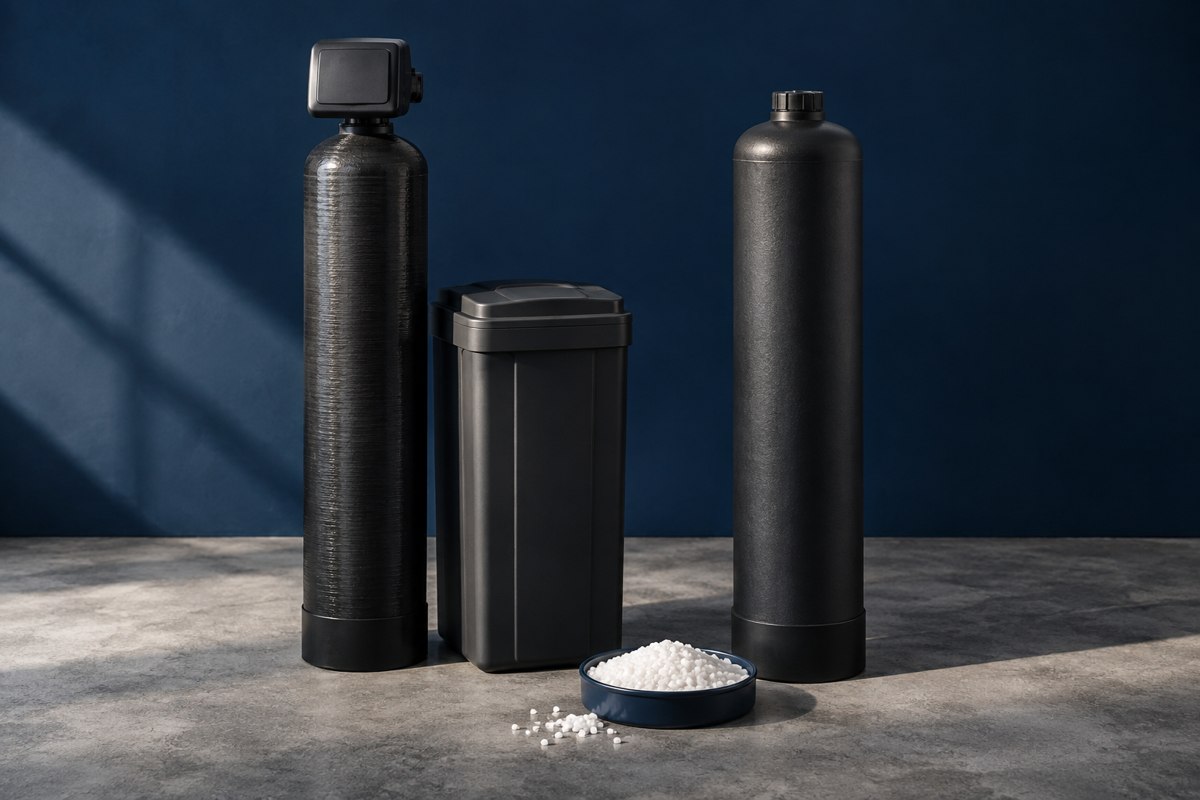
One company calls it a softener. Another calls it a conditioner. A third promises salt-free treatment. When you’re looking at similar tanks and very different promises, it’s easy to wonder whether you’re comparing the same thing.
Start with what the equipment does to the water. The label alone won’t tell you whether it removes hardness, manages scale, filters a particular substance, or combines several treatments.
A salt-based softener removes hardness
A conventional softener uses ion exchange to remove calcium and magnesium hardness. With sodium-chloride salt, it exchanges those hardness ions for sodium. Salt is used during regeneration to restore the resin’s ability to soften water. The system needs salt replenishment and a drain for regeneration water. Read the water-softening research report (PDF).
This is the category to discuss when you want actual hardness reduction. A softener isn’t automatically a complete drinking-water treatment system. Other concerns may call for another treatment stage.
Salt-free scale treatment has a different job
Some salt-free systems use template-assisted crystallization, often shortened to TAC. They are designed to reduce scale formation while leaving the hardness minerals in the water. That means scale treatment and softened water are different outcomes. These details describe TAC systems, not every product sold as “salt-free.” Read the WateReuse research summary.
Ask about media replacement and other upkeep for the system being proposed. Results also depend on the equipment and the water it treats; findings from a study do not guarantee the same result in every home.
“No salt” tells you something about upkeep. It doesn’t, by itself, tell you what results to expect at the shower, sink, or water heater.
“Conditioner” needs a closer look
Treat this as a starting label. Ask what technology is inside that particular unit. Is the recommendation for hardness removal, scale control, filtration, or a combination?
The same equipment can appear under more than one description. A package may also contain separate stages with different jobs. Comparing the names without looking at those stages can make very different proposals sound identical.
The useful comparison
| Description | Main distinction | Question to ask |
|---|---|---|
| Salt-based softener | Removes hardness minerals through ion exchange. | What upkeep and regeneration will this model require? |
| Salt-free TAC treatment | Targets scale formation; hardness minerals remain. | What results and water conditions does this model specify? |
| Conditioner | The name alone does not establish the treatment. | What is inside, and what does each stage do? |
Why professional design matters
At Twin Lakes, we start with your water and what you’d like to improve. We also look at your plumbing, how your household uses water, the installation space, and the care a proposed system will need.
Then we explain the recommendation in plain language: what each part is there to do, what it won’t do, and whether more than one treatment is needed. You shouldn’t have to work that out from a product name.
Where a product carries certification, the exact model and listed reduction claims matter. A certification logo does not mean a system removes every contaminant. NSF explains how to read those claims.
You can bring another proposal or a product name to the conversation. We’ll help you understand what you’re comparing before you decide.